Migrating from AngularJS to Modern Angular: A Practical Guide
Raj · Aug 30, 2026 · 5 min read
A step-by-step approach to moving legacy AngularJS applications to Angular 20 while the product keeps running.
AngularJS reached end of life at the end of 2021. Applications still running on it receive no security patches,
struggle with modern browsers and tooling, and are increasingly hard to hire for. Rewriting everything at once
is risky, so we migrate step by step while the product stays live.
What modern Angular gives you
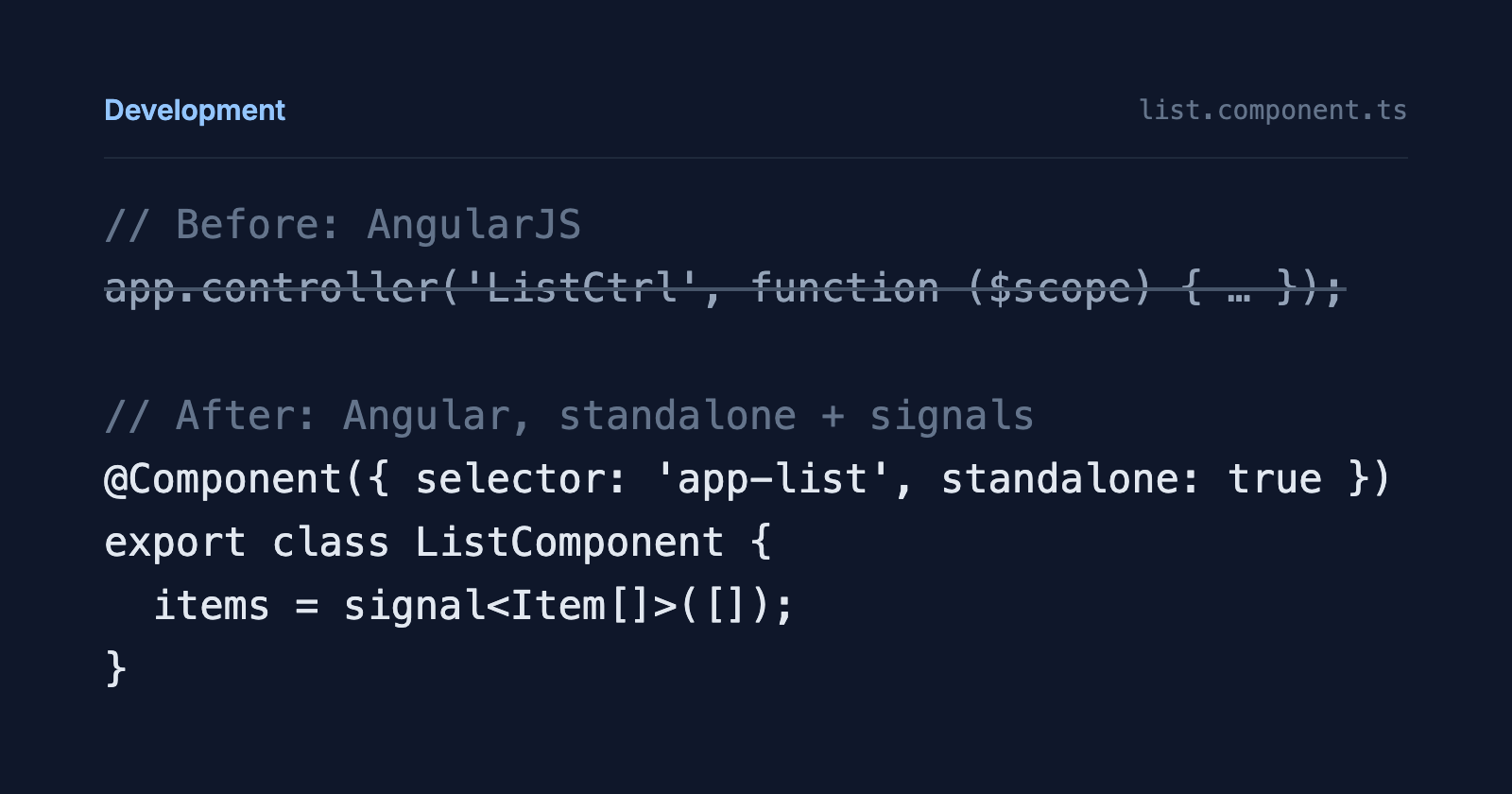
Standalone components: no NgModules to maintain, simpler lazy loading and clearer dependencies.
Signals: fine-grained reactivity that's easier to reason about than watchers and digest cycles.
Built-in control flow:@if and @for in templates, with better performance.
Modern tooling: fast esbuild-based builds, strict TypeScript and first-class testing.
Our migration approach
Audit: map routes, controllers, services and third-party libraries, and identify what can be deleted rather than migrated.
Prepare the AngularJS code: move to components and one-way bindings, and adopt TypeScript, so the gap to modern Angular shrinks.
Run hybrid: bootstrap both frameworks together with the official upgrade tools, so old and new screens live in one app.
Migrate feature by feature: start with shared services, then move screens one at a time behind the same routes, with tests for each.
Remove AngularJS: once the last screen moves, drop the hybrid layer and modernize with standalone components and signals.
Avoiding common pitfalls
Don't migrate dead code. The audit usually finds screens nobody uses.
Agree on a design system early so migrated screens don't look different from the rest.
Release often. Small, frequent releases keep risk low and show progress to stakeholders.